AI Shubka
  • Home
No Result
View All Result
AI Shubka
  • Home
No Result
View All Result
AI Shubka
No Result
View All Result
  • Home
  • Affiliate & Tool Guides
  • AI & Future Tech
  • AI Learning & Tutorials
  • Business & Digital Strategy
  • Gadgets & Reviews
  • Motivation & Personal Growth
Can YOU spot the fake faces? Take the test to see if you can distinguish between real and AI-generated people – as study reveals most of us are overconfident

Can YOU spot the fake faces? Take the test to see if you can distinguish between real and AI-generated people – as study reveals most of us are overconfident

ShubkaAi by ShubkaAi
February 19, 2026
in AI & Future Tech, AI breakthroughs (GPT updates, generative models), Best AI tools for creators, Robotics & automation, Tech forecasts
0
585
SHARES
3.2k
VIEWS
Summarize with ChatGPTShare to Facebook


If you think you can spot the difference between a real face and one generated by artificial intelligence (AI), you’re probably wrong, according to a new study.

Researchers from the University of New South Wales, in Australia, say people are overconfident about their ability to spot a fake face.

With AI faces now almost impossible to distinguish from real ones, this misplaced confidence could make people more vulnerable to scammers and fraudsters, they warned.

While it used to be easy to spot fake faces by looking for obvious visual mistakes – such as distorted teeth, glasses that merged into faces and ears that didn’t quite attach properly – it’s becoming much harder.

‘Ironically, the most advanced AI faces aren’t given away by what’s wrong with them, but by what’s too right,’ Dr Amy Dawel said.

‘Rather than obvious glitches, they tend to be unusually average – highly symmetrical, well–proportioned and statistically typical.’

If you think you can spot any digital trickery, take the quiz below to see how well you distinguish real and AI–generated faces.

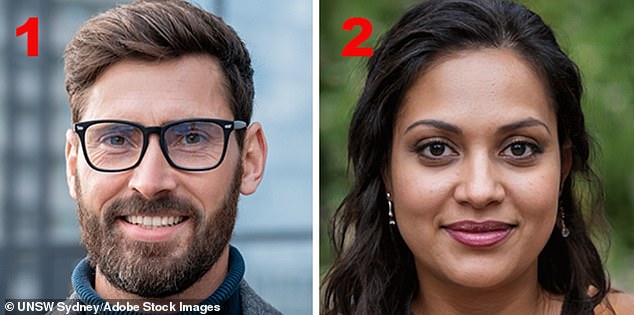
In each pair of faces, one is real, and one is fake. How many can you spot?

Researchers from the University of New South Wales, in Australia, say people are overconfident about their ability to spot a fake face. In this pair, the AI–generated face is number 2

Researchers from the University of New South Wales, in Australia, say people are overconfident about their ability to spot a fake face. In this pair, the AI–generated face is number 2

Researchers warned it's becoming much harder to spot a digital fake, as obvious visual mistakes no longer occur thanks to advances in technology. In this pair, the AI–generated face is number 3

Researchers warned it’s becoming much harder to spot a digital fake, as obvious visual mistakes no longer occur thanks to advances in technology. In this pair, the AI–generated face is number 3

As part of their study, the researchers recruited 125 participants to complete an online test in which they were shown a series of faces and asked to judge whether each image was real or made by AI.

Participants included 89 ‘normal’ people and 35 people with exceptional face–recognition ability, known as ‘super recognisers’.

‘Up until now, people have been confident of their ability to spot a fake face,’ said co–author Dr James Dunn.

‘But the faces created by the most advanced face–generation systems aren’t so easily detectable anymore.’

Their analysis revealed that normal people performed only slightly better than chance. And while super–recognisers performed better than other participants, it was only by a ‘slim margin’.

‘What was consistent was people’s confidence in their ability to spot an AI–generated face, even when that confidence wasn’t matched by their actual performance,’ Dr Dunn said.

The team explained that facial qualities such as symmetry and average proportions usually signal attractiveness and familiarity. But in the current study, they become a red flag for artificiality.

‘It’s almost as if they’re too good to be true as faces,’ Dr Dawel explained.

Analysis revealed that normal people performed only slightly better than chance. And while super–recognisers performed better than other participants, it was only by a slim margin. In this pair, the AI–generated face is number 5

Analysis revealed that normal people performed only slightly better than chance. And while super–recognisers performed better than other participants, it was only by a slim margin. In this pair, the AI–generated face is number 5

The experts said fake faces now tend to be unusually average – highly symmetrical, well–proportioned and statistically typical. In this pair, the AI–generated face is number 8

The experts said fake faces now tend to be unusually average – highly symmetrical, well–proportioned and statistically typical. In this pair, the AI–generated face is number 8

How to spot an AI–generated face

  • Faces that look ‘too right’ – which are highly symmetrical, well–proportioned and statistically typical.
  • The teeth are misaligned, or there are the wrong number of teeth in the smile.
  • The nose looks wrong or has strange patterns where it meets the face.
  • The hairline is blurred or goes in a strange direction at the edges.
  • The ears are mismatched, misaligned, or have non–matching earrings.
  • The eyes are unnaturally asymmetrical or wonky, and the reflections don’t line up.

The findings also carry practical implications, the team said, as relying on visual judgement alone is no longer reliable.

This matters in contexts ranging from social media and online dating to professional networking and recruitment, where people often assume they can ‘just tell’ when a profile picture looks fake.

Misplaced confidence may leave individuals and organisations more vulnerable to scams, fake profiles and fabricated identities, they warned.

‘There needs to be a healthy level of scepticism,’ Dr Dunn said. ‘For a long time, we’ve been able to look at a photograph and assume we’re seeing a real person. That assumption is now being challenged.’

Rather than teaching people tricks to spot synthetic faces, the broader lesson is about updating assumptions, the researchers said.

The visual rules many of us rely on – like blurry backgrounds or distorted features – were shaped by earlier, less sophisticated systems.

‘As face–generation technology continues to improve, the gap between what looks plausible and what is real may widen – and recognising the limits of our own judgement will become increasingly important,’ Dr Dawel said.

What interested the researchers was how readily even super–recognisers were fooled.

Misplaced confidence may leave individuals and organisations more vulnerable to scams, fake profiles and fabricated identities. In this pair, the AI–generated face is number 9

Misplaced confidence may leave individuals and organisations more vulnerable to scams, fake profiles and fabricated identities. In this pair, the AI–generated face is number 9

Some people, however, were excellent at spotting AI–generated faces, suggesting there may be 'super–AI–face–detectors' out there. In this pair, the AI–generated face is number 11

Some people, however, were excellent at spotting AI–generated faces, suggesting there may be ‘super–AI–face–detectors’ out there. In this pair, the AI–generated face is number 11

While this group did perform better on average, the advantage was modest, and their accuracy remained far below what they typically achieved when recognising real human faces.

There was also substantial overlap between groups, with some non–super–recognisers outperforming super–recognisers – demonstrating this is not simply an experts–versus–everyone–else problem.

The team, who published their findings in the British Journal of Psychology, said they may have stumbled upon a new kind of face recogniser.

‘Our research has revealed that some people are already sleuths at spotting AI–faces, suggesting there may be ‘super–AI–face–detectors’ out there,’ Dr Dunn added.

‘We want to learn more about how these people are able to spot these fake faces, what clues they are using, and see if these strategies can be taught to the rest of us.’


Source link

SummarizeShare234
ShubkaAi

ShubkaAi

Related Stories

Reddit on the rise: What is it and why is AI search popularising it?

Reddit on the rise: What is it and why is AI search popularising it?

by ShubkaAi
March 1, 2026
0

If you do a Google search nowadays, you no longer see a list of links at the very top. Instead, you see a summary of search results curated...

Share values of property services firms tumble over fears of AI disruption | AI (artificial intelligence)

US military reportedly used Claude in Iran strikes despite Trump’s ban | AI (artificial intelligence)

by ShubkaAi
March 1, 2026
0

The US military reportedly used Claude, Anthropic’s AI model, to inform its attack on Iran despite Donald Trump’s decision, announced hours earlier, to sever all ties with the...

Can ‘friction-maxxing’ fix your focus?

Can ‘friction-maxxing’ fix your focus?

by ShubkaAi
March 1, 2026
0

Thrilled by his initial success, the artist has now traded the instant gratification of Instagram for longer and more meaningful interactions on Substack, takeaways for home-cooked meals and...

SaaS-pocalypse isn’t coming any time soon • The Register

SaaS-pocalypse isn’t coming any time soon • The Register

by ShubkaAi
March 1, 2026
0

Opinion Say goodbye to the SaaS-pocalypse theory, which posits that advances in AI will bring the software-as-a-service market to its knees. Say hello to "a feedback loop with...

Next Post
The rise of AI is making the future of work look bleak – but it could be an opportunity | AI (artificial intelligence)

The rise of AI is making the future of work look bleak – but it could be an opportunity | AI (artificial intelligence)

Leave a Reply Cancel reply

Your email address will not be published. Required fields are marked *

Ai Shubka

AI-Shubka | Smarter Business. Automated Future. Helping entrepreneurs and creators earn more with AI tools, automation, and digital strategy.

Follow us

Recent Posts

On the Future of Species — unnatural selection – Financial Times

On the Future of Species — unnatural selection – Financial Times

March 1, 2026
New to Claude? Use these 6 simple starter prompts to unlock better answers instantly

New to Claude? Use these 6 simple starter prompts to unlock better answers instantly

March 1, 2026

Weekly Newsletter

© 2026 aishubka - Smarter Business. & Automated Future. by aishubka.

Powered by
►
Necessary cookies enable essential site features like secure log-ins and consent preference adjustments. They do not store personal data.
None
►
Functional cookies support features like content sharing on social media, collecting feedback, and enabling third-party tools.
None
►
Analytical cookies track visitor interactions, providing insights on metrics like visitor count, bounce rate, and traffic sources.
None
►
Advertisement cookies deliver personalized ads based on your previous visits and analyze the effectiveness of ad campaigns.
None
►
Unclassified cookies are cookies that we are in the process of classifying, together with the providers of individual cookies.
None
Powered by
No Result
View All Result
  • Home
  • Affiliate & Tool Guides
  • AI & Future Tech
  • AI Learning & Tutorials
  • Business & Digital Strategy
  • Gadgets & Reviews
  • Motivation & Personal Growth

© 2026 aishubka - Smarter Business. & Automated Future. by aishubka.